

Australian Companion Dog Skills
A national, assessment-based certification pathway for companion dogs — from early puppy foundations to advanced community reliability.
Australian Companion Dog Skills (ACDS) provides a structured framework for evaluating real-world companion dog behaviour, handling, and emotional regulation across progressive levels.
WHAT MAKES ACDS DIFFERENT

Independent Assessment
Training and assessment are separate. Certification is awarded based on observed criteria, not participation.

Real-World Focus
Skills are evaluated in practical environments with realistic distractions.

Progressive Pathway
Dogs may enter at the level appropriate to their current skill set.
THE ACDS PATHWAY

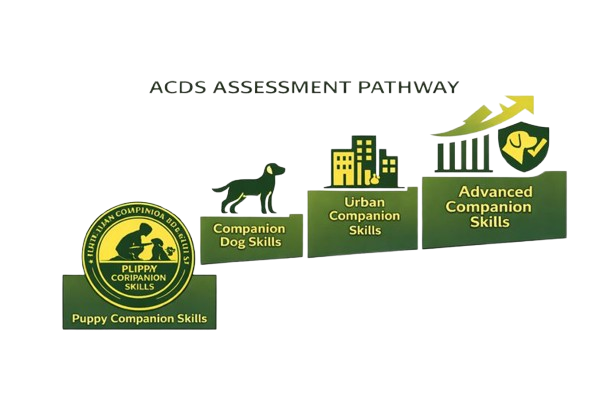
Four progressive levels designed to reflect developmental stage, environmental complexity, and behavioural reliability.
Assessment features:
Conducted in a group environment
Developmentally appropriate expectations
Focus on comfort, engagement, and early skill foundations
Level 1 — Puppy Companion Skills
(6 months of age and under)
Puppy Companion Skills recognises early development, calm participation, and appropriate behaviour in structured social settings.
This level is designed to support puppies during critical learning periods without requiring formal obedience or precision behaviours.
Examples of skills assessed may include:
tolerance of handling and gentle restraint
calm engagement with handler
basic positions and transitions
short lead walking
early recall foundations
Level 2 — Companion Dog Skills
Companion Dog Skills is the core ACDS certification and reflects reliable behaviour expected of a well-managed companion dog.
This level evaluates everyday manners, handling tolerance, and behavioural stability in low- to moderate-distraction environments.
Assessment features:
Group or individual assessment formats
Focus on practical, real-world skills
Suitable for adolescent and adult dogs
Examples of skills assessed may include:
loose lead walking
polite greeting behaviour
basic stays and recall reliability
calm neutrality around people and dogs
handling tolerance
Level 3 — Urban Companion Skills
Urban Companion Skills evaluates a dog’s ability to remain calm, responsive, and appropriately managed in public and community environments.
This level reflects the increased complexity and unpredictability of real-world settings.
Assessment features:
Conducted in public or simulated public environments
Group or individual assessment formats
Emphasis on neutrality and resilience
Examples of skills assessed may include:
controlled movement in public spaces
passing people, dogs, and environmental distractions
settling in public locations
appropriate responses to sudden stimuli
Level 4 — Advanced Companion Skills
Advanced Companion Skills is the highest level of ACDS certification.
This level recognises advanced reliability, emotional regulation, and handler–dog teamwork under complex or high-distraction conditions.
Assessment features:
Advanced environments or scenarios
High expectations for consistency and control
Focus on stability rather than obedience performance
Examples of skills assessed may include:
extended calm behaviour in challenging environments
reliable responses under distraction
advanced lead handling and transitions
consistent neutrality and recovery
Training, Assessment, and Level Progression
Australian Companion Dog Skills (ACDS) is a structured assessment framework, not a training program.
Participation in training does not guarantee certification
Dogs may be assessed regardless of where or how they were trained
Certification is awarded solely on assessment performance
Assessment structure and progression requirements
To ensure consistency, safety, and fairness across all evaluators and environments, ACDS operates as a progressive, criteria-based assessment system with defined entry and progression requirements.
Puppy Companion Skills (Level 1) is a developmental assessment for dogs six months of age and under.
This level must be undertaken within a group class conducted by an approved ACDS evaluator, ensuring consistent social context and standardised assessment conditions.
Level 1 is age-limited and not a prerequisite for progression into the core pathway.Companion Dog Skills (Level 2) is the mandatory foundation level of the ACDS framework.
Dogs must successfully complete Level 2 before progressing to any higher-level assessment.Urban Companion Skills (Level 3) may only be undertaken following successful completion of Level 2.
Advanced Companion Skills (Level 4) may only be undertaken following successful completion of Level 3.
This structured progression ensures that dogs assessed at higher levels have demonstrated the prerequisite skills required for increased environmental complexity, behavioural reliability, and public exposure.
The clear separation of training and assessment, combined with mandatory progression requirements and defined assessment contexts, protects the integrity, neutrality, and consistency of the Australian Companion Dog Skills framework across all evaluators.